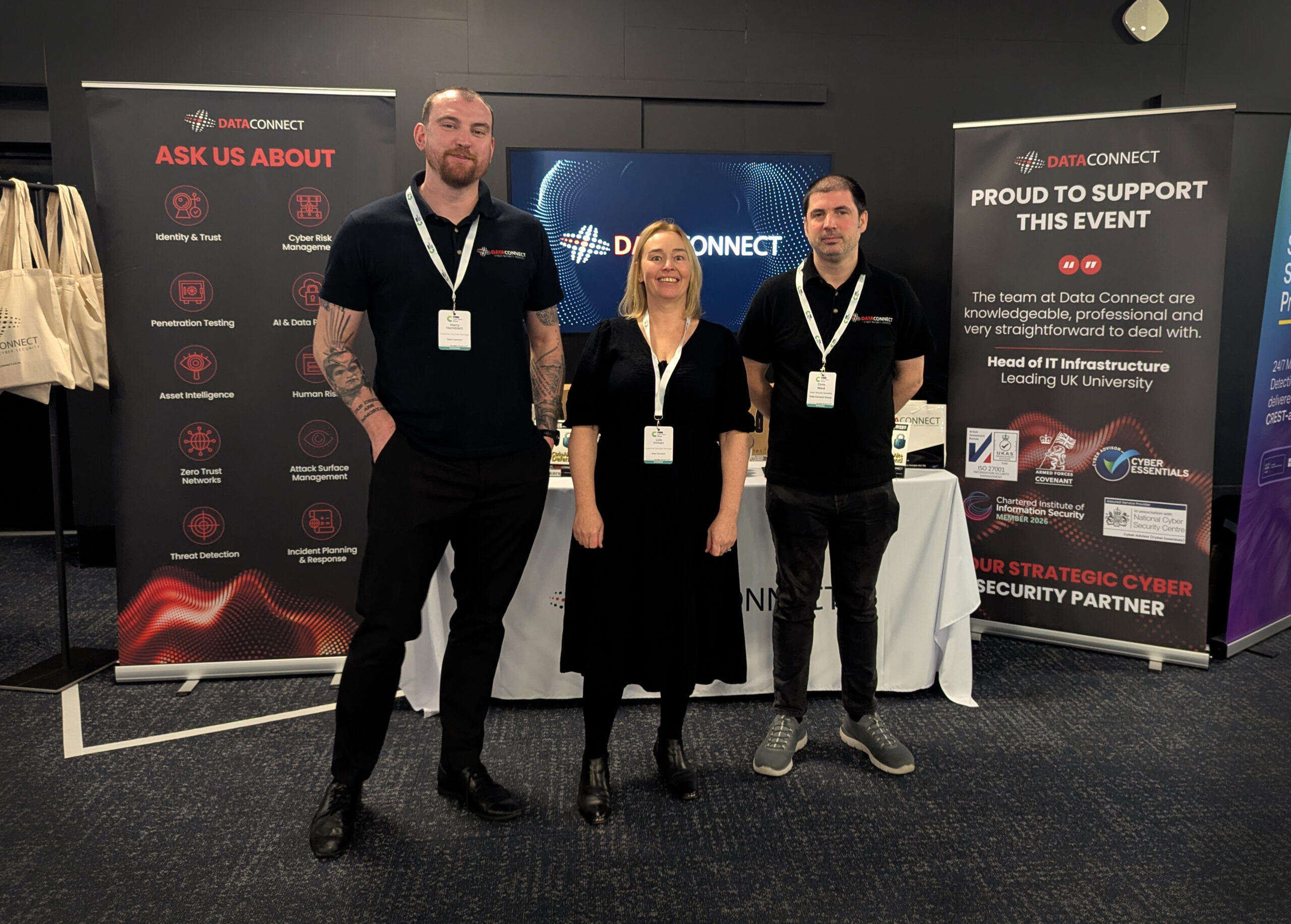
Bringing cyber security conversations closer to the organisations they affect is something worth supporting. That’s why Data Connect was proud to sponsor and exhibit at the first Leeds edition of The Future of Cyber Security. Being a Yorkshire-based business and a strategic cyber security partner to many local organisations, it was great to see the event come to Leeds where the local community can discuss how we build stronger, more resilient organisations.
For senior leaders and IT teams, there is no shortage of security challenges competing for attention. The harder task is deciding what deserves investment, what needs to change and where to start.
Reflecting on the themes of the event, these are our ten takeaways for businesses.
1) Attackers do not always need to hack their way in
A convincing request from a supposed colleague, supplier or senior leader can be enough to trigger a payment, expose sensitive information or grant access.
These attacks exploit trust, urgency and familiar working relationships rather than technical vulnerabilities. Telling employees to “be vigilant” is not enough if the processes around them make it easy for a fraudulent request to succeed.
Awareness training matters, but it needs to be supported by clear procedures that make verification normal, even when a request appears to come from someone senior.
Our takeaway: Introduce independent checks for sensitive requests, including payment changes, password resets and requests for access. Verify through a known contact route, rather than the details supplied in the request.
2) Every technology decision is also a security decision
New technology can help businesses improve productivity, serve customers better and stay competitive. Security should support those ambitions, rather than appear as a last-minute obstacle.
When security teams are involved early, they can help the business understand the risks and find a practical way forward. Leaving those conversations until a system is ready to launch can lead to avoidable costs, delays or risks being accepted without proper consideration.
The aim is not to eliminate every risk before introducing something new. It is to make informed decisions about which risks the business is prepared to take and how they will be managed.
Our takeaway: Bring security into discussions about new technology from the outset. Consider the business benefits and security requirements together, so protection is part of the solution rather than an afterthought.
3) Recovery deserves as much attention as prevention
Preventing an attack remains important, but prevention cannot be the only measure of a successful security strategy.
Businesses also need to understand how they would operate if key systems became unavailable. Could orders still be processed? Could staff contact customers? How long could the organisation function without access to its core data? Only last week we had to deal with another stark reminder of how dependent we all can be on certain systems, with the outage of Microsoft causing global disruption.
All these questions turn cyber security from a technical discussion into a business one.
Our takeaway: Start with the services your business cannot afford to lose, then work backwards to the systems, people and recovery capabilities needed to keep them running.
4) Test your recovery before you need it
A successful backup does not tell you how quickly your business could get back to work after an attack. The real test is whether you can restore the systems and information people need, with disruption kept within acceptable limits.
Testing recovery gives you the opportunity to uncover problems while there is still time to fix them. It also helps leadership teams understand what recovery would involve, rather than relying on assumptions.
Our takeaway: Test the recovery of a critical business service, not just individual files. Check whether it can be restored within the time your business needs and address any gaps the exercise reveals.
5) Fast reporting matters more than a perfect-looking scorecard
A low phishing click rate may look positive on a report, but it does not tell you how effectively the organisation responds when something goes wrong.
An employee who immediately reports a mistake gives the business a chance to contain it. An employee who fears the consequences may stay silent.
That makes reporting culture an operational security issue, not simply an HR consideration.
Our takeaway: Make suspicious activity easy to report and respond without blame. Alongside awareness metrics, look at how quickly concerns reach someone who can act.
6) An incident response plan needs to work under pressure
During a cyber incident, difficult decisions often need to be made before the full picture is clear. Taking a system offline could limit an attacker’s access, but it could also stop the business delivering a critical service. Who has the authority to make that call?
An effective response plan needs to do more than list contacts and procedures. It should establish who leads the response, who can authorise action and how teams will communicate if their usual systems are unavailable.
Working through these questions in advance helps prevent uncertainty from becoming a costly delay.
Our takeaway: Rehearse a realistic scenario with technical teams and senior leaders. Check whether responsibilities are clear, decisions can be made promptly and communication holds up under pressure.
Read our What Not to Do in the First 24 Hours After a Cyber Attack blog.
7) AI governance has to work in the real world
If employees find an AI tool useful, a policy alone is unlikely to determine whether they use it.
Organisations need to understand what people are trying to achieve, which tools they are using and what information they are sharing. Without that visibility, governance risks addressing an idealised version of the workplace rather than the real one.
The aim should be to enable useful adoption while setting clear boundaries around risk.
Our takeaway: Give employees practical guidance on approved tools, sensitive data and checking outputs. Make sure the secure option is a workable one.
8) Closing the gap between detection and action
Visibility matters, but an alert only creates value if someone can investigate it and take appropriate action.
Organisations can invest in detection without fully resolving what happens next: who reviews the warning, how it is prioritised and who has permission to contain the threat? This is particularly important outside normal working hours.
Our takeaway: Assess the whole response process. The important question is not just “can we detect this?” but “can we act on it quickly enough?”
9) Compliance should be a starting point, not the definition of success
Compliance can help secure investment, clarify responsibilities and bring cyber security to the attention of the board. Its value, however, depends on what changes as a result.
If an assessment leads to stronger access controls, tested recovery arrangements or better supplier oversight, it is supporting resilience. If it only produces updated paperwork, the underlying risks may remain.
For business leaders, the question should not simply be “have we met the requirement?” but “how has this made us better protected?”
Our takeaway: Connect compliance activity to clear security outcomes. Ask what risk each requirement addresses and what evidence shows that the measures in place are working.
10) Cyber security culture is shaped by leadership behaviour
The way leaders respond to security concerns sends a clear message about how seriously the business takes them. Asking for risks to be explained, making time to address weaknesses and following through on agreed improvements all demonstrate that security matters.
The opposite sends a message too. If concerns are repeatedly deferred or responsibility is left unclear, employees may stop believing that raising an issue will lead to action.
A strong security culture needs more than encouragement from the top. It needs consistent attention and visible follow-through.
Our takeaway: Make cyber security a regular leadership discussion. When concerns are raised, assign a clear owner, agree the next steps and check that action has been taken.
Stronger organisations help build a more resilient Yorkshire
Organisations across Yorkshire face many of the same challenges, having a place to exchange perspectives and discuss practical responses can help strengthen resilience across the wider community.
For us, the priority now is turning those conversations into action. That does not mean launching ten new projects at once. It means identifying where your business is most exposed, checking the assumptions behind your current approach and choosing the improvements that will make the greatest difference.
If these takeaways have raised questions about your organisation’s security, contact us today and our team will be happy to help. We can help you assess your current position, prioritise practical improvements and strengthen your cyber resilience.