How to Avoid a Cyber Attack

Cyber attacks cannot be avoided completely, but the risk of a successful attack can be reduced significantly.

For large organisations, prevention depends on more than having the right tools in place. It requires a clear understanding of where the organisation is exposed, who owns each risk, how well controls are performing, what remediation is overdue and (through ongoing validation and oversight) whether cyber risk is actually reducing over time.

The most effective approach is to combine practical security controls with strong governance, continuous monitoring and tested response planning giving you continuous assurance. That means looking beyond basic prevention checklists and asking whether your organisation can prove that its most important risks are being managed effectively.

Data Connect supports this through vSOC Assure, helping leadership and IT teams build a clearer, measurable view of cyber risk and the actions needed to reduce exposure.

How to Avoid a Cyber Attack

Reducing the likelihood of a successful cyber attack

For many large organisations, the biggest cyber risk is not a lack of security tools, it's limited visibility and the assumption that these tools are doing their job.

Large businesses often operate across multiple sites, cloud platforms, legacy systems, third-party providers, privileged users, remote access routes and business-critical applications. That complexity makes it difficult to know which risks are genuinely under control and which are simply assumed to be managed. A cyber attack usually succeeds where there is a gap.

That gap might be an unpatched internet-facing system, a supplier with excessive permissions, an unmanaged privileged account, a misconfigured cloud service, an endpoint not covered by monitoring or an incident response plan that has never been tested. The challenge is knowing which gaps matter most, who's responsible for them and what should be done first. 

“Increasing budgetary allocation on cyber security tooling and ticking compliance boxes is simply not enough to prepare an effective and resilient 'real world' cyber strategy. Independent validation, dynamic risk metrics and understanding of overall posture across the business at any given time, is crucial to ensuring efficacy is realised and spend is optimised.”

Simon Kean, Data Connect's Head of Customer Success
What most cyber attack prevention advice misses

What most cyber attack prevention advice misses

Most advice focus on the physical controls including to patch systems, train users, use MFA, back up data and secure access. Those controls matter. They are part of a good security baseline.

But for larger organisations, this is harder to manage and requires a different approach, starting with questions like:

- Who is responsible for each cyber risk?
- Which critical systems are not covered by monitoring?
- Which vulnerabilities are outside agreed remediation timeframes?
- Which third parties have access to sensitive systems?
- Where are controls assumed rather than evidenced?
- Which risks fall outside the agreed risk appetite?
- Can the board see whether risk is reducing over time?
- Has recovery been tested for the services that matter most?

This is where cyber attack prevention becomes a governance and resilience issue, not just a technical checklist.

A mature organisation does not only ask, “Do we have controls in place?” It asks, “Are those controls working, are they proportionate to our risk and can improvement be tracked and evidenced?"

What helps prevent a successful cyber attack?

Clear cyber risk ownership

Clear cyber risk ownership

Cyber risk should be understood by the board, managed by the right operational teams and reviewed as part of wider business resilience.

That means material risks need named owners, clear remediation actions and agreed reporting routes. Without ownership, cyber issues can remain visible but unresolved.

Asset and exposure visibility

Asset and exposure visibility

You cannot protect what you cannot see. Organisations need a reliable view of critical systems, users, data, vulnerabilities, suppliers, cloud environments and internet-facing assets.

This is especially important where legacy systems, acquisitions, shadow IT or third-party platforms have created unknown exposure.

Secure configuration and access control

Secure configuration and access control

Systems should be configured securely, unnecessary access should be removed and privileged accounts should be tightly managed.

For large organisations, this should include regular access reviews, MFA coverage for critical services, monitoring of privileged activity and clear controls around third-party access.

Vulnerability and patch management

Vulnerability and patch management

Known weaknesses should be prioritised based on risk, not just technical severity. A vulnerability on an isolated low-value system does not carry the same business impact as a known exploited vulnerability on an internet-facing service that supports critical operations. Prevention depends on understanding that distinction.

Monitoring and detection

Monitoring and detection

Security teams need the ability to spot suspicious activity quickly, reduce dwell time and respond before an incident becomes a major disruption.

That requires monitoring coverage across the systems that matter most, including identity platforms, endpoints, cloud services, critical applications and network activity.

Incident response planning

Incident response planning

Response plans, escalation routes and communication processes should be tested before they are needed.

A plan that has not been exercised with IT, security, legal, communications, senior leadership and business continuity teams may not work under pressure.

Security awareness and behaviour

Security awareness and behaviour

People remain a core part of cyber resilience. Your training programme content should be targeted and relevant and reinforced over time through regular testing and refresher sessions.

Completion rates are not enough. Organisations should also look at reporting rates, repeat risk behaviours and whether high-risk departments receive role-specific guidance.

Supply chain assurance

Supply chain assurance

Suppliers, partners and managed service providers can introduce risk. Their controls, access permissions and responsibilities should be understood and reviewed.

A supplier with remote access to critical systems can become part of your attack surface, even if your internal controls are strong.

CLEARER RISK. STRONGER DECISIONS.
The Benefits of Structured Cyber Risk Management

CLEARER RISK. STRONGER DECISIONS.

A structured approach to cyber risk management gives leadership and IT teams a clearer view of where risk sits, which controls are working and where action is needed most.

vSOC Assure helps identify risk across critical assets, privileged access, third-party dependencies, unresolved vulnerabilities, monitoring gaps and incident response readiness. It does this by challenging assumptions through ongoing testing and review, so you gain a more accurate picture of exposure rather than relying on isolated reporting.

It also provides independent assurance, so teams are not effectively “marking their own homework”. External validation strengthens confidence in the findings and helps confirm whether controls are operating as intended.

Finally, it helps bridge the gap between the board and IT by translating technical findings into clear risk priorities, practical actions and measurable business impact.

WHY PREVENTION IS A BUSINESS ISSUE
Why Cyber Attack Prevention Matters

WHY PREVENTION IS A BUSINESS ISSUE

Cyber risk is no longer just an IT issue. A successful attack can affect operations, revenue, regulatory confidence, customer trust, supplier relationships and board-level assurance.

For large organisations, the impact can spread quickly. A single compromised account, supplier weakness or unpatched system can disrupt multiple services, locations or departments.

That is why prevention needs to be treated as a business resilience priority. Leaders need to understand which systems and data are most critical, where the organisation is most exposed, which risks need investment and how prepared the business is to respond if an attack occurs.

IDENTIFYING RISKS TO ACTION
How vSOC Assure Works

IDENTIFYING RISKS TO ACTION

vSOC Assure provides a structured process for understanding, validating and reducing cyber risk.

We begin by assessing your current security posture and identifying the risks that matter most. From there, our team validates findings using technical expertise, recognised frameworks and practical business context.

The result is a prioritised remediation roadmap aligned to your organisation’s goals, risk appetite and maturity. This helps your teams focus on the actions that will reduce the greatest exposure first.

TRACK PROGRESS AND DRIVE IMPROVEMENT
vSOC Connect Console

TRACK PROGRESS AND DRIVE IMPROVEMENT

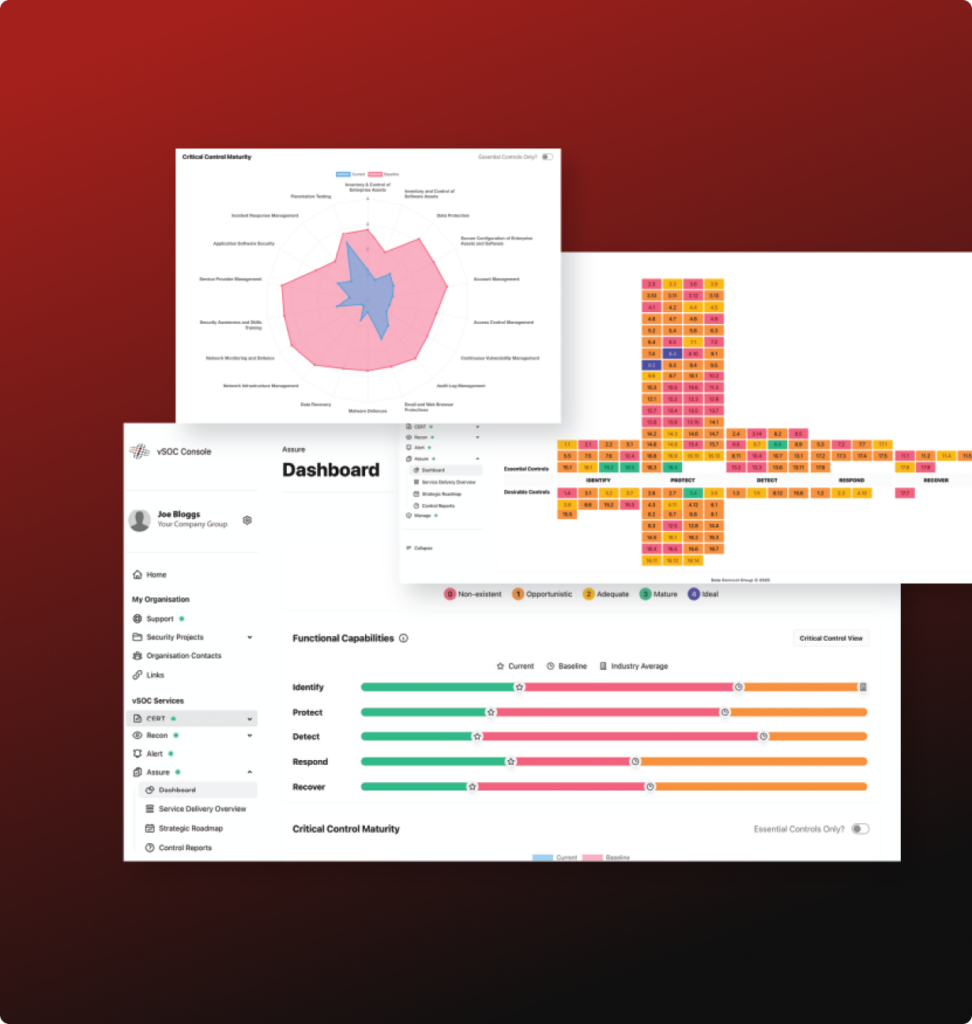
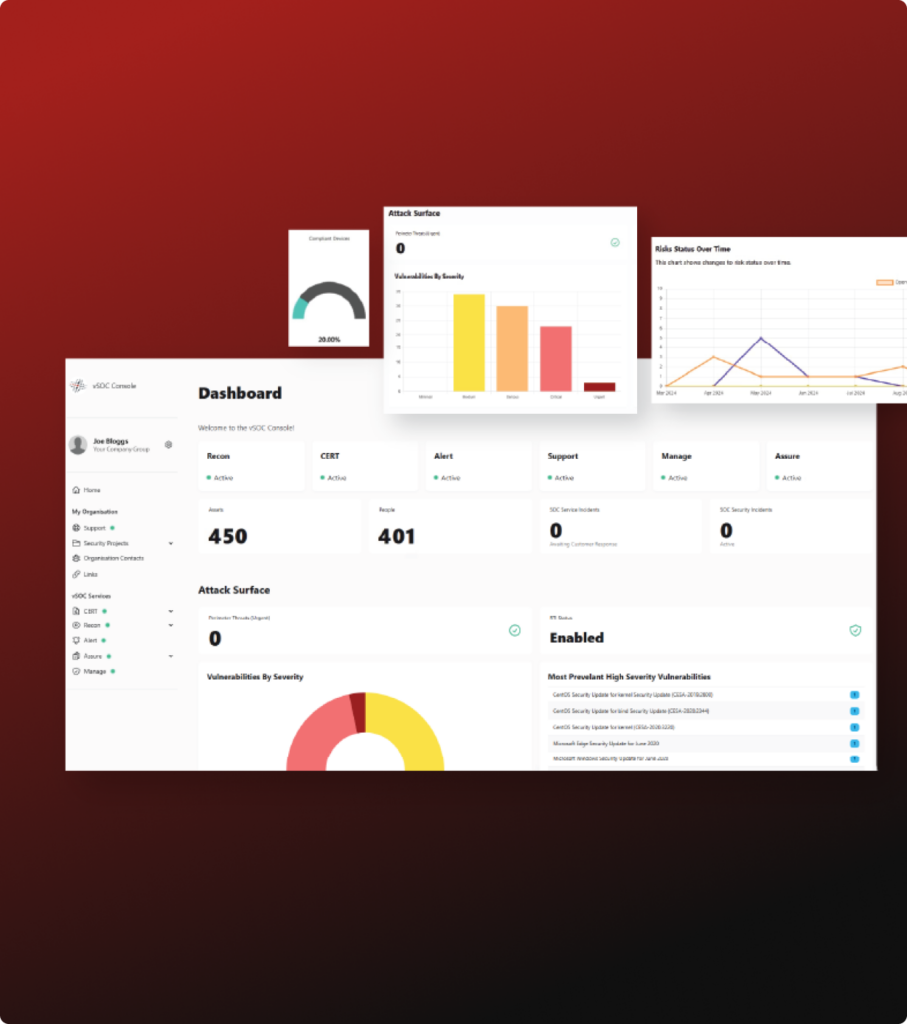
The vSOC Connect Console gives leadership and IT teams a central view of cyber risk, remediation activity and service performance.

It brings together actionable risk analysis, security project tracking, maturity progression and service visibility in one place. This helps your organisation measure improvement over time and keep cyber risk management connected to wider business priorities.

Alongside vCISO support and industry benchmarking, it helps turn cyber risk management into an ongoing, measurable process rather than a one-off assessment.

Why Data Connect?

Why Data Connect?

Fortify your security defences with vSOC Assure

Developed over the past decade based on real-world challenges and evolving security needs, our service is specifically designed to foster a unified cyber security approach between the board and IT teams.

  • Proven Expertise: A strong track record of helping organisations understand and mitigate their cyber risk exposure.
  • Client Success: Empowering clients to make confident decisions leading to measurable success and long-term resilience.
  • Access to Accredited Professionals: Tap into a wider skills pool with access to security veterans, subject matter experts and highly experienced CISOs.
  • Demand-Driven Assurance: This service combines proven know-how, real-world experience and a genuine understanding of our clients' needs.

Testimonials

When it comes to renewal time, we get a lot of other providers contacting us, offering alternative solutions. The fact we’ve stayed with Data Connect for so long is testament to how much we value the relationship and how pleased we are with the solutions provided.

Head IT Support Engineer | Industrial Services | 800+ Employees

Testimonials

Our business has now worked with Data Connect for over a decade. They’re more than a supplier; they’re our security partner. They’re prepared to put the hours in to get you into the security position you need to be in.

Information Systems Manager | Food Service | 500+ Employees

Testimonials

Without the experienced human expertise provided by Data Connect, we wouldn’t have got as far as we did. It’s important to say, right from the start, they were incredibly helpful to me personally, as someone that doesn’t ‘speak the language’. When I asked questions, never once was there a raised eyebrow or a patronising response.

Clients Director of Corporate Services | Not-for-Profit | 50+ Employees

FAQs

What are the outcomes of a successful cyber attack?

+
-

What can happen if your organisation is targeted by a cyber attack?

Successful cyber attacks can result in a wide range of consequences, including:

  • - Malware and ransomware infections
  • - Data breaches and loss of personal or customer information
  • - Supply chain compromises
  • - System sabotage or operational disruption
  • - Theft of intellectual property or funds
  • - Reputational damage and loss of customer trust

Training staff to recognise early warning signs helps prevent these outcomes and builds a proactive line of defence.

What are the five core pillars for reducing the risk of a cyber attack?

+
-

An effective cyber security strategy typically focuses on five connected core areas: Identify, Protect, Detect, Respond and Recover.

  • Identify: Understand what you need to safeguard: critical systems and data, who owns them, key dependencies, vulnerabilities and the most likely/high-impact risks.
  • Protect: Put proportionate safeguards in place across people, process and technology (e.g. access controls, patching, secure configuration, backups, security awareness).
  • Detect: Monitor systems and users to spot suspicious activity early (e.g., logging, alerting, endpoint and network monitoring).
  • Respond: Have clear incident response plans, roles and escalation paths so you can contain, investigate and communicate quickly when something happens.
  • Recover: Restore services and data safely, minimise downtime and improve controls based on lessons learned (including testing backup and recovery procedures).

No single control prevents every attack, but addressing all five areas reduces exposure, improves early detection, limits impact and helps you recover faster.

What is vSOC Assure and how does it help manage cyber risk?

+
-

vSOC Assure is our structured cyber risk management service that helps identify, assess and reduce your organisation’s risk exposure through strategic planning, expert technical support and actionable insights via the vSOC Connect Console.

vSOC Managed Services

vSOC Assure

Navigate cyber risk with a trusted security partner. Pinpoint your current risk exposure and how to overcome these security gaps. Benefit from a combination of real-world risk analysis, benchmarking, vCISO support and actionable recommendations to drive strategic cyber maturity, all whilst dramatically reducing risk.

vSOC CERT

Stop Cyber Essentials from being a headache once a year. vSOC CERT streamlines and supports the entire certification lifecycle, from preparation to audit, keeping you compliant and secure all year round.

vSOC Manage

Achieve optimal performance whilst ensuring a secure environment with vSOC Manage. Whether you're trying to achieve Zero Trust, maintain SASE, SD-WAN or perimeter defences, our qualified and experienced team are here to help.

vSOC Recon

Secure your environment with confidence and reduce your risk exposure. Our attack surface management service, vSOC Recon, helps you understand risks, prioritise vulnerabilities and take decisive action.

vSOC Alert

24x7 actionable intelligence, delivering business resilience and trusted protection. If you are looking for a service to proactively detects threats, reduce dwell time and respond fast, vSOC Alert is right for you.

vSOC Aware

Human error is the #1 cause of security breaches. Our security awareness training and phishing simulation service equips your team to spot phishing, avoid threats and stay proactive. Reduce risk with your bespoke training programme.

Resources
Using our extensive knowledge of cyber security, we’ve worked to create and provide some excellent resources that help you to approach cyber security within your organisation.