Manufacturing environments are built for performance, precision and uptime but when it comes to cyber security, gaps in communication between IT (Information Technology), OT (Operational Technology) and leadership can leave organisations exposed. Without clear alignment, important risks can go unidentified or underestimated.
Technical teams often speak in highly specialised language, while executives remain focused on KPIs and operational performance. At the same time, OT systems operate with their own priorities and constraints, often separate from traditional IT oversight. Without a unified view, the full picture of cyber risk can fail to reach the right decision-makers. In manufacturing, this disconnect is particularly alarming. Cyber incidents don’t just impact data, they can bring production lines to a standstill, delay shipments, disrupt supply chains and even introduce safety risks on the factory floor.
Risks Facing the Manufacturing Industry
The manufacturing sector presents a unique and complex threat landscape, including:
- Legacy systems and outdated security protocols that are difficult to patch or replace without disrupting operations
- Industrial IoT (IIoT) devices, increasing connectivity but also expanding the attack surface
- Operational Technology (OT) environments, where production systems were not originally designed with cyber security in mind
- Intellectual property theft, particularly for organisations involved in design, engineering or proprietary processes
- Supply chain vulnerabilities, where third-party access or disruption can lead to significant production downtime
The recent Jaguar Land Rover (JLR) cyber attack is a stark example of the scale of impact these incidents can have. The attack forced production shutdowns across multiple sites, disrupted thousands of suppliers and is estimated to have cost the UK economy around £1.9 billion, making it one of the most financially damaging cyber events in UK history.
In response, the UK government stepped in to support the wider supply chain, highlighting how cyber incidents in manufacturing can quickly escalate beyond a single organisation and become a national economic concern. It was reported the month after the attack that some businesses within the chain had only “seven to 10 days of money left” due to the attack and halt in production. It is also believed to be the first time that a company has received government help as a result of a cyber attack.
Departmental Silos Explained:
Whilst no two organisations are identical, there are a lot of similarities when it comes to structure, operations and culture. One aspect we have seen time and time again, unfortunately, is departmental silos.
If this is a new concept, we’ve created a simple diagram to explain what it is and how it impacts cyber security.
- IT (Information Technology): Responsible for corporate systems, networks and data security. IT teams typically lead on cyber security initiatives, but often have limited visibility or control over production environments.
- OT (Operational Technology): Responsible for production systems, machinery and industrial control environments. The primary focus is uptime, safety and efficiency, meaning security measures can sometimes be secondary to operational continuity.
- Leadership / Operations: Focused on business performance, output, cost and efficiency. While ultimately accountable for risk, leadership may not always have full visibility into the technical or operational cyber risks across IT and OT.
Cyber security does not sit neatly within any one of these areas. As a result, responsibility can become blurred, creating gaps where risks are not fully owned, understood or addressed. This lack of clear ownership makes it difficult to maintain a consistent and effective security posture across both IT and production environments.
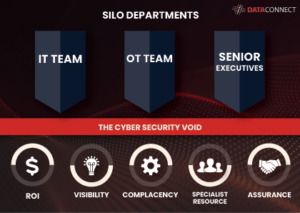
Explaining the Cyber Security Void
The void, an ominous name, reflects the fact that problems in these five areas can lead to negative consequences.
Visibility:
Visibility remains one of the most critical components of cyber security, particularly in manufacturing environments where IT and OT operate across different systems, networks and priorities. A single unseen vulnerability can have serious consequences, from halting production to impacting safety on the factory floor.
In many organisations, IT teams have strong visibility over corporate systems, while OT environments (such as production machinery, programmable logic controllers (PLCs) and control systems) are far less monitored. As a result, each silo operates with a different level of visibility and decisions are often made in isolation. This “siloed decision-making” means risks can be assessed without acknowledging the full picture, creating gaps where threats can go undetected.
Without a unified view across IT, OT and leadership, organisations may believe they are secure, when in reality, critical exposures remain hidden.
Maximising Existing investment:
In manufacturing environments, cyber security investments are often shaped by legacy infrastructure, operational constraints and the need to maintain continuous uptime. Many organisations are running critical production systems on older technologies that cannot be easily upgraded, patched or replaced without introducing risk to operations. This can limit how newer security tools are deployed and integrated, particularly across OT environments.
As a result, organisations often face challenges in identifying where improvements can realistically be made and where investment will have the greatest impact. By taking a more holistic approach, one that considers both IT and production environments, organisations can better utilise existing tools, reduce duplication and simplify the management of cyber risk while improving return on investment.
Specialist Resource:
Cyber security in manufacturing requires a blend of IT, OT and security expertise, yet all these skillsets cannot exist within a single individual or even a small team. Engineers understand production systems, IT teams understand infrastructure and cyber specialists understand threats, but bringing these disciplines together is a challenge.
For many organisations, particularly mid-sized manufacturers, building a fully resourced in-house security team is not feasible and expecting one individual to cover all areas, from network security to industrial control systems, is unrealistic. A more practical approach is to identify key risk areas, prioritise them, then assess resources and consider solutions or services that can address multiple gaps simultaneously.
Complacency:
In established manufacturing environments, long-standing processes and systems can lead to a level of complacency. Production uptime is often prioritised above all else, meaning systems are left unchanged for long periods, especially within OT environments.
At the same time, assumptions can build between departments. Leadership may expect IT to manage all aspects of cyber risk, while IT and compliance teams rely heavily on periodic assessments such as audits or penetration tests. Without continuous communication and validation, these assumptions can create gaps where risk is underestimated or overlooked.
Assurance:
Closely linked to complacency is the concept of assurance. Many organisations have defined roles, processes and procedures in place, but without regular validation, it can be difficult to confirm whether they are being followed effectively.
In manufacturing, this is particularly important where IT and OT processes may differ significantly. Relying on documentation or historic practices is not enough, organisations need ongoing verification that controls are working as intended across both environments.
Ultimately, cyber security is a shared responsibility across IT, OT and leadership but for it to become embedded within the organisation, it must be driven from the top and supported by a culture of accountability and continuous improvement.
Senior leaders can utilise the NCSC’s Cyber Security Toolkit for Boards as an additional resource. You can also read our Deciphering the NCSC’s Cyber Security Toolkit for Boards blog here.
Tips to Bridge the Gaps Between IT, OT & Leadership
Understanding the challenges is one thing, addressing them effectively is another. In manufacturing environments, where IT, OT and leadership operate with different priorities, reducing the “cyber security void” requires a coordinated approach. Here are six key steps to improve alignment and strengthen cyber resilience:
1) Define Clear Roles and Responsibilities
In many manufacturing organisations, accountability for cyber security is unclear, particularly across IT and OT environments. IT teams are often expected to manage all aspects of security, despite limited visibility or control over production systems.
Clearly defining roles, responsibilities and ownership across IT, OT and leadership is essential. By understanding internal capabilities, resource limitations and current risk posture, organisations can set realistic expectations and have more informed discussions about the pace and direction of cyber maturity.
2) Provide Targeted Training Across All Levels
While cyber security is a growing priority at board level, many decision-makers come from operational or commercial backgrounds rather than technical ones. At the same time, OT teams may have limited exposure to cyber risk beyond system uptime and reliability.
Targeted training, workshops and scenario-based exercises (such as production-focused tabletop simulations) can help bridge this knowledge gap. These sessions should focus on real-world manufacturing scenarios, enabling leadership and operational teams to better understand cyber risk, its potential impact on production and their role in managing it.
3) Adopt an Integrated IT/OT Risk Management Approach
Cyber risk in manufacturing cannot be managed in isolation. IT and OT environments are increasingly interconnected, meaning risks in one area can quickly impact the other.
Bringing together IT, OT and leadership to conduct joint risk assessments and strategy sessions helps build a shared understanding of threats and priorities. Establishing regular reporting and communication ensures cyber risk is consistently visible at leadership level, transforming it from a reactive issue into a strategic consideration.
4) Establish a Unified View of Risk
Having partial visibility is no longer enough. Each function, IT, OT and leadership, often has its own perspective of risk, which can lead to decisions being made without full context.
A unified, holistic view across all environments is critical. This enables more informed, collaborative decision-making, particularly when it comes to prioritising investments, managing production risks and allocating resources. Without this alignment, organisations risk overlooking smaller vulnerabilities that can combine into larger, more damaging incidents.
5) Build a Practical, Phased Cyber Security Roadmap
In manufacturing, change must be carefully managed to avoid disrupting operations. Attempting to implement large-scale transformation too quickly can introduce additional risk.
Instead, organisations should develop a strategic roadmap aligned to both business objectives and operational constraints. By setting clear, achievable goals and prioritising improvements based on risk, organisations can make steady progress without compromising production stability.
6) Challenge Assumptions and Validate Controls
Assumptions between departments, such as “IT has it covered” or “this system is secure because it always has been”, can lead to false assurance.
Regular validation of controls, processes and responsibilities is essential, particularly across IT and OT environments where practices may differ significantly. Encouraging open communication and constructive challenge helps ensure that risks are properly understood and managed, rather than being overlooked or accepted by default.
Continuous Real-World Cyber Risk Assurance
If you are committed to bridging the gap between IT, OT and leadership but need further support, Data Connect can help.
Through vSOC Assure, our cyber risk management service, we work with manufacturing organisations to manage cyber risk across both corporate systems and production environments. Our service brings together IT, OT and leadership, ensuring cyber risk is clearly understood, communicated and managed across the organisation.
With access to our vSOC Connect Console and support from our expert cyber security team, including vCISOs and subject matter experts, we help you navigate the practical challenges of securing manufacturing environments, balancing cyber resilience with the need for continuous uptime.
By taking a holistic, real-world approach, you’ll gain greater visibility into your risk landscape, improve collaboration between teams and build confidence in both your security posture and operational resilience.