What Is the Toolkit and Why Was It Created?
Cyber security has traditionally been treated as a technical discipline, something handled by IT teams, security specialists and external vendors. But as organisations have become fundamentally dependent on digital systems to operate, cyber incidents have evolved into business-critical events: they can halt operations, interrupt revenue, trigger regulatory action and permanently damage customer trust.
Recognising this shift, the UK’s National Cyber Security Centre (NCSC), working with the Department for Science, Innovation and Technology (DSIT), has produced a set of board-level resources to help directors govern cyber risk with the same seriousness and structure as financial, legal or operational risk.
As Richard Horne, CEO of the NCSC, puts it:
The Cyber Security Toolkit for Boards is just one part of the board level resources created by the NCSC. There are 3 components: 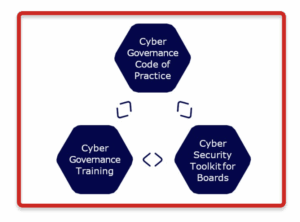
Who are the NCSC?
The National Cyber Security Centre (NCSC) is the UK’s technical authority for cyber security and is part of GCHQ. The tagline that summarises their purpose is “Helping to make the UK the safest place to live and work online.”
In practice, the NCSC:
- Understands cyber security and distils this knowledge into practical guidance that it makes available to all.
- Responds to cyber security incidents to reduce the harm they cause to organisations and the wider UK.
- Uses industry and academic expertise to nurture the UK’s cyber security capability.
- Reduces cyber risk to the UK by helping public and private sector organisations improve their security through the measures above.
Cyber risk is business risk, not just “IT risk”
Boards are well equipped at understanding how to govern finance, legal exposure, health and safety and reputational risk, but cyber risk has often been understated in the boardroom.
A ransomware incident, for example, isn’t primarily an encryption problem, it’s a business interruption problem. Likewise, a data breach isn’t mainly a security incident, it’s a trust, compliance and liability problem.
The challenge is that cyber is often discussed in language that doesn’t map neatly to business decision-making. Leaders are fluent in revenue, liability and shareholder value, but cyber discussions can become overly technical and therefore disconnected from strategy.
To address this, the NCSC also published guidance on “Engaging with Boards to improve the management of cyber security risk”, aimed at helping CISOs and security leaders communicate in board-relevant terms: impact, likelihood, options, cost and residual risk.
Also, you can read Bridging the Gap Between IT & Leadership: Communicating Cyber Risk to the Board – Data Connect
Put simply: cyber risk must be translated into business risk so boards can approve and prioritise mitigations intelligently.
Instead of “we need to patch servers,” the conversations needs to be:
- What happens if the factory stops for five days?
- What happens if the website goes offline during peak trading?
- What happens if a breach triggers ICO scrutiny, customer churn, contractual penalties or brand damage?
Once cyber security is framed this way, it becomes far easier for boards to govern it effectively.
Security Culture: Not a Technical Problem, a Leadership Problem
One of the most overlooked drivers of cyber resilience is organisational culture. Technology matters, but culture determines whether good controls are actually followed, whether incidents are reported early, whether risk is escalated and whether teams treat security as “how we do business” rather than “extra admin.”
Improving cyber risk culture is therefore not just a CISO responsibility, it’s a board and leadership responsibility. Boards set the tone from the top, shape incentives and decide what gets prioritised and funded.
Cyber Governance for Boards: the programme behind the toolkit
The Cyber Security Toolkit for Boards sits within a wider NCSC initiative called Cyber Governance for Boards, created in partnership with DSIT.
This includes:
Together, these aim to give boards meaningful oversight and assurance that cyber risks are being managed, not just “reported.”
The Cyber Governance Code of Practice: Five Governance Principles
At the heart of the approach is the Cyber Governance Code of Practice, built around five key governance principles:
- Risk Management
- Strategy
- People
- Incident Planning, Response and Recovery
- Assurance and Oversight
Each principle comes with specific governance actions for boards to implement. The intent is simple: if boards embed these principles, they’ll govern cyber security more consistently and more effectively, rather than relying on ad hoc updates, one-off projects or technical reassurance.
Why Boards and Directors Should Use This Guidance?
Cyber incidents can:
- Disrupt business continuity and day-to-day operations
- Reduce competitiveness and slow strategic delivery
- Damage customer trust and brand reputation
- Create regulatory and contractual consequences
- Increase costs through downtime, recovery, legal support and remediation
And crucially, cyber criminals exploit weaknesses in systems regardless of sector or size. That’s why cyber resilience is now central to protecting an organisation’s financial stability.
Just as importantly, good cyber governance enables organisations to confidently adopt digital transformation and emerging technologies (including AI). The goal isn’t to slow innovation, it’s to enable it safely, by understanding and managing risk rather than ignoring it.
For many organisations, the Toolkit and Code can become the first point of reference for board members: a shared framework and vocabulary for asking the right questions, setting expectations and measuring progress.
How Organisations Are Meant to Use the Toolkit in Practice
Used well, the NCSC Boardroom Toolkit helps boards move from passive awareness to active governance. That typically looks like:
- Putting cyber on the board agenda as a standing governance topic (not just after incidents)
- Agreeing risk appetite: what level of disruption/data loss is tolerable?
- Setting direction: ensuring cyber supports business strategy and digital change
- Clarifying ownership: who is accountable for cyber risk at exec level and how is it escalated?
- Testing readiness: incident response, recovery capability and decision-making under pressure
- Seeking assurance: evidence, metrics, independent validation, not just “status reports”
The toolkit is especially valuable because it helps boards challenge and support executives without requiring directors to become cyber experts.
Key Takeaways
The NCSC’s board-level resources reflect a modern reality: cyber resilience is a leadership issue. The Cyber Governance Code of Practice, supported by training and the Boardroom Toolkit, gives directors a practical way to govern cyber risk like any other business risk, through strategy, accountability, culture, preparedness and assurance.
If organisations want to be resilient and to take advantage of digital opportunities without being blindsided by digital threats, this is exactly the kind of structured, board-owned approach that’s been missing for too long.
How Can Data Connect Help
The Cyber Governance Code of Practice and Toolkit is a powerful resource for boards but turning it into day-to-day governance can take time, focus and internal capacity. At Data Connect, we’ve been guiding organisations through this level of cyber risk management for more than a decade, using an approach that closely aligns with the Code and Toolkit.
Partnering with us helps you accelerate the journey, you’ll move from guidance to action faster with a seasoned team on hand to answer questions, cut through complexity and help your organisation mature with confidence.
With vSOC Assure, our Cyber Risk Management service, we help organisations move from cyber guidance to measurable action, bringing leadership and technical teams together to strengthen resilience and make better, faster risk decisions.
- Align IT teams and Boards around shared cyber risk priorities
- Reduce cyber risk and consolidate security efforts into a coordinated programme
- Provide clear strategic direction and governance support
- Deliver continuous risk analysis, external validation and industry benchmarking against recognised standards
- Create a practical, prioritised risk roadmap supported by vCISO-level advisory
- Enable full visibility of your security posture and confident, evidence-led investment decisions